
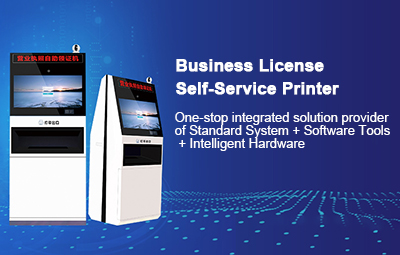
The Business License Self-Service Issuance Service is an innovative service designed to improve public convenience and reduce counter workload.. It adopts online application via WeChat and offline license collection at self-service kiosks. Authorized applicants complete real-name authentication, verify license information, and submit profile records online. They then get the license by face recognition at the kiosk—secure, reliable, and consistent with regulatory requirements. Shifting real-name authentication to the WeChat front end greatly shortens on-site operations and improves kiosk efficiency.
The kiosk system uses a centralized server deployment model, supporting convenient local management and remote maintenance, which significantly reduces terminal maintenance costs.
Ⅰ.Self-Service kiosks Terminal
Main Configuration of Self-Service Kiosk Terminal | |||
Table 1 Configuration Parameters of Self-Service Kiosk Terminal | |||
No. | Module Name | Configuration Parameters | Model & Specification |
1 | Display Screen | Resolution: 1920*1080; Response time: ≤16ms; Viewing angle: ≥120°(H)/≥100°(V); Brightness: ≥300 cd/㎡; Dot defect rate: Meets Grade A panel standard, no two bright dots too close | 23.6 inch |
2 | Touchscreen | Capacitive screen; Response time: ≤16ms; Surface hardness: Level 7; Positioning accuracy: ≤2mm; Service life: ≥50,000,000 touches | 23.6 inch |
3 | Industrial Control Computer | Motherboard: LGA1150; 8×USB ports, 6×COM ports, 1×Gigabit Ethernet port; | Industrial-grade Control Motherboard |
CPU: Boxed i5, 3.0GHz, LGA1150;
| |||
RAM: 8GB DDR3 1333MHz; SSD: 256GB | |||
4 | Power Supply |
Industrial mainboard power board: Overvoltage/overcurrent/short-circuit protection; Load regulation: ±1% typical; Voltage regulation: 0.5% typical; Ripple & noise: 1% peak-to-peak; MTBF: >50,000 hours;
| 12_5A |
LCD backlight power board; | |||
12V power board | |||
5 | Cabinet | Dimensions: 1600mm×700mm×700mm | — |
6 | ID Card Reader |
MTBF: 5,000 hours; Reading distance: 5cm; Compliant with ISO/IEC 14443 Type A/B; Certified by the Security and Police Electronic Product Quality Inspection Center of the Ministry of Public Security; Contactless reading of 2nd generation ID card information
| HD-900 |
7 | Facial Recognition Camera | Micro embedded H.264 backlight monitoring; 2MP dedicated facial recognition camera | DWT |
8 | Monitoring | 700-line, 2.8mm lens; | — |
Hard disk recorder; | |||
1TB SATA 6Gb/s 64MB surveillance hard disk | |||
9 | A3 Printer | Type: Monochrome laser printer; Max print format: A3; Print speed: 30ppm; Max resolution: 1200×1200dpi; Input capacity: 250-sheet standard tray, multi-purpose tray; Network printing: Wired network printing supported | 2 additional 500-sheet paper trays |
10 | Timing Switch Control | Emergency start button; | SPK |
Timing on/off module: Supports remote and local on/off time control | SPK | ||
Ⅱ. Self-Service licensing service software
1. WeChat application system
The entitled licensee completes the self-service license application through the WeChat application system, and the system interface is shown in Figure-5-1 to Figure-5-4. Authorized applicants submit requests via WeChat: verify business information, complete real-name authentication, confirm license details, and select a pickup location. Upon submission, the system sends the pickup address and verification code via WeChat.
2. Self-service licensing system
The applicant gets the license through the self-service license system, and the system interface is shown in Figure-6-1 to Figure-6-6. At the selected location, applicants who successfully apply for a self-service license enter the pickup code or scan the QR code, complete facial verification, retrieve application data, and print the license with one click.
3. Self-Service kiosk management system
At least one administrator per hall logs in via WeChat for daily management: network security, blank license/paper inventory, low-stock alerts, fault detection, and remote technical support. The system supports network security configuration, blank license and paper inventory management, paper-out alerts, equipment fault detection, and fault reporting to request technical support from the central team. System interfaces are shown in Figures 7-1 to 7-7.
4. Central management and monitoring system
This system is for operators to centrally manage and monitor self-service printers across all government service halls. It processes self-service license applications in real time, monitors equipment status, handles fault requests, and provides real-time statistics and alerts for printing volume and remaining blank licenses, ensuring stable operation of all self-service printers.
Ⅲ. Deployment Method
The kiosk system adopts a central server deployment architecture. All software and databases are deployed in the central equipment room. Kiosk terminals in government halls or commercial banks access the central server via the special network of the State Administration for Market Regulation or dedicated bank lines, with mandatory security access control. This architecture ensures system and data security (no data or software is stored locally on kiosks) and reduces terminal maintenance. All software and data updates are managed centrally by professional technicians; on-site staff only need to handle routine consumable maintenance.